
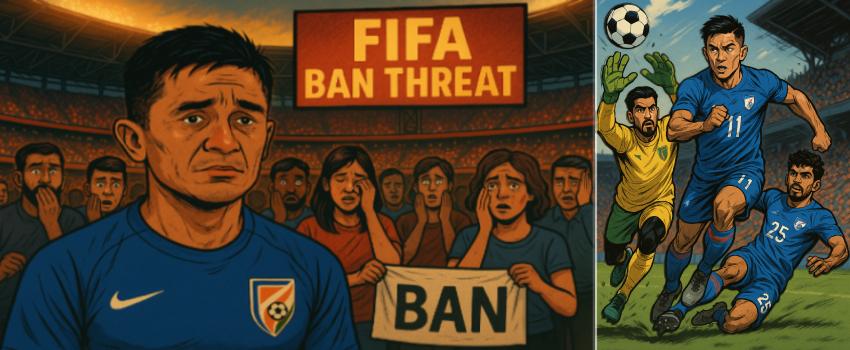
The dark cloud of a FIFA suspension has once again gathered over Indian football. For the second time in just three years, the All India Football Federation (AIFF) finds itself on the brink of being banned from international competition. This move would halt the progress of the sport in a country of 1.4 billion people. The threat, issued in a stern joint letter from world governing body FIFA and the Asian Football Confederation (AFC), is a direct consequence of the AIFF’s prolonged failure to finalize and adopt its revised constitution, a matter that has been languishing in the Indian Supreme Court since 2017.
The Echo of 2022: A History of Governance Crisis
This latest development is a painful echo of the crisis that engulfed the sport in August 2022. At that time, FIFA imposed a ban on the AIFF citing “undue influence from third parties,” which is a serious violation of its statutes. The “third party” in question was the Supreme Court-appointed Committee of Administrators (CoA) that was overseeing the federation’s affairs. The court had stepped in to address the fact that the then-president, Praful Patel, had overstayed his term, having been in charge for over 12 years—a clear violation of India’s National Sports Code. The legal battle to remove the long-serving committee and hold fresh, democratic elections ultimately led to the suspension.


The consequences of that 2022 ban were immediate and severe. The most significant was the stripping of India’s right to host the FIFA U-17 Women’s World Cup, a tournament scheduled to be held in the country just a few months later. National teams were barred from competing, and Indian clubs lost their eligibility for continental tournaments. The ban effectively isolated Indian football from the global community.
The Resolution of the Last Ban
The urgency of the situation forced swift action. The Supreme Court terminated the mandate of the CoA, paving the way for the AIFF to conduct its long-delayed elections. In a historic moment, Kalyan Chaubey, a former professional footballer, was elected as the new AIFF president on September 2, 2022. With the administrative structure now back in the hands of an elected body, FIFA and the AFC were satisfied that the third-party interference had been removed, and they lifted the ban just ten days after it was imposed. India’s hosting rights for the U-17 Women’s World Cup were reinstated, and the immediate crisis was averted.
The New Ultimatum: A Deadline from FIFA and AFC
However, the core issue of the new constitution was never fully resolved. The Supreme Court held that while the judgment on the constitution was “ready,” it needed to defer pronouncement to examine the implications of the recently enacted National Sports Governance Act, 2025. This legal limbo has created what FIFA and AFC now describe as an “untenable vacuum and legal uncertainties at the heart of Indian football.”
In the new ultimatum, issued in a letter to AIFF president Kalyan Chaubey on August 26, 2025, FIFA and the AFC have set a clear deadline of October 30, 2025, for the AIFF to take three binding and immediate actions. Firstly, the federation must secure a definitive order from the Supreme Court approving the revised constitution. Secondly, the constitution must be fully aligned with the mandatory provisions of the FIFA and AFC Statutes. And finally, the AIFF must obtain formal ratification of the new constitution from its general body. The letter leaves no room for ambiguity and warns that “failure to meet this schedule will leave us with no alternative but to refer the matter to the relevant FIFA decision-making body for consideration and decision.”
The Collateral Damage: ISL and the Players
This latest threat comes at a particularly precarious time for the sport in India. The letter from FIFA and AFC explicitly points out that the prolonged legal and administrative impasse has already precipitated a governance and operational crisis. The most prominent example is the uncertainty surrounding the Indian Super League (ISL). The league’s commercial partnership agreement with Football Sports Development Limited (FSDL) is set to expire in December 2025, and a new deal has been stalled by the ongoing constitutional issues and a separate Supreme Court directive preventing the AIFF from signing new commercial contracts.
This has left the upcoming ISL season in limbo, with clubs facing an existential crisis, and the livelihoods of thousands of players and staff hanging in the balance. The players’ union, FIFPRO, has even raised concerns with FIFA over the unilateral termination of player contracts by various clubs.
A Path Forward: The Four-Point Blueprint
In an effort to resolve the ISL crisis, the AIFF and FSDL representatives met on August 25, 2025, in what they described as “constructive and positive” discussions. They are now working on a four-point blueprint to present to the Supreme Court. This framework prioritizes transparency to counter allegations of opacity in governance, and continuity to prevent a premature end to the current season while safeguarding long-term interests.
Crucially, any solution must achieve triple compliance: adhering to India’s newly enacted National Sports Governance Act, 2025, which was recently signed into law by President Droupadi Murmu, as well as the FIFA and AFC statutes.
Also Read: The ISL on Pause: Why India’s Top League is Being Delayed for a Radical Overhaul
A Nation’s Hope on a Knife’s Edge
The core principle at stake, as it was in 2022, is the independence of a national football federation. FIFA’s statutes mandate that member associations must operate without any undue influence, be it from government bodies or judicial systems. While the intentions of the Indian legal system to ensure good governance may be sound, the protracted nature of the process has put the AIFF in a difficult position, caught between a national judiciary and a global governing body. A suspension would once again mean national teams and clubs being barred from all international competitions, a setback that would not only halt the momentum gained but could also jeopardize India’s ambitious bid to host the 2036 Olympic Games.
The federation is scheduled to present its joint proposal with its commercial partners to the Supreme Court on August 28, 2025, a crucial step in resolving the ISL crisis. Ultimately, the future of Indian football hinges on its ability to navigate this complex web of legal, administrative, and sporting challenges. The 2022 ban was a wake-up call; this latest threat is a final warning that a failure to establish a stable and autonomous governance framework will have devastating consequences. The ails of a fragile administrative structure continue to overshadow the potential of a nation with a burgeoning love for the beautiful game.